Alice Espanet
Las madres noAlice Espanet, formerly known as Jade, is a mother whose twins’ deaths become the center of a criminal trial and a public argument about mental illness and responsibility. Her story is also filtered through The Narrator, who recognizes her as someone encountered eleven years earlier, when she was living under another name. That recognition makes Alice more than the accused in a case: she becomes the point where memory, testimony, and the limits of what can be known collide.
Identity and the name Jade
For much of her early life, Alice was known as Jade. The Narrator remembers having lived next door to her for a week, eleven years before the revelation, and recalls her as a young woman encountered before either of them understood much about pain. At the time of that recognition, The Narrator had avoided media images of Alice and had not thought of the earlier acquaintance for years. The connection returns abruptly during labor, when pain and memory bring the two versions of the woman together.
The interval between Jade and Alice remains largely unaccounted for. Through Léa, The Narrator learns something of Alice’s life up to around the age of twenty-one or twenty-two, but a gap of three or four years follows. The change of name is one of the few clear markers in that silence: in The Narrator’s formulation, Jade dies and Alice begins. Léa offers possible explanations, including that Jade may have seemed unsuitable for the social class Alice aspired to, or that the name was chosen in defiance of her mother, but she does not treat either as certain. Alice kept her mother’s surname, Espanet. The narrative supplies no definitive reason for the change, leaving identity itself as one of the case’s unresolved questions.
Marriage and fertility treatment
Two months after meeting Ritxi in Burdeos, Alice had moved to Vitoria-Gasteiz. Weekend visits became week-long stays, and then, almost imperceptibly, she transferred her belongings to the attic apartment Ritxi owned in the city center. The Narrator describes those belongings as a suitcase full of makeup and another full of clothes. Ritxi introduced Alice to his friends at a dinner; they remembered her as young, beautiful, and discreet, but little else. A wedding invitation arrived within months, without surprising them.
The couple’s long effort to have children is recalled later in the fertility clinic where The Narrator searches for information. A receptionist remembers Alice and Ritxi’s treatment, though Alice has become a taboo subject there. After three cycles of insemination, involving injections, scans, and follicle counts, pregnancy had not occurred. The clinic recommended in vitro fertilization, a longer, more expensive, painful, and dispiriting process. The couple agreed, having already gone beyond what the narrative calls the point of no return. The clinic staff had regarded Alice as an ordinary patient, but the receptionist recalls her as extreme in her emotional swings, at times high and at times in a hole, never moderate. The account offers that impression without turning it into a diagnosis.
The deaths and the hospital aftermath
When Mélanie, the au pair, returned to the House of Armentia after her Thursday afternoon off, she approached quietly, hoping the twins might be asleep. On the landing she felt a vibration and experienced what she later described as an urge to flee, but continued down the corridor. In the partly open bedroom she saw the twins on their parents’ bed, almost entirely covered by the duvet, and Alice seated beside them in a chair, wearing a nightdress with her left breast exposed. Mélanie came closer in a state of trembling; during those five steps, she felt her mind empty and herself disappear. The scene gives the deaths an immediate witness, but offers no access to Alice’s state of mind at that moment.
After the twins were found dead, Alice was detained and taken to Hospital de Santiago. The psychiatrists on duty described her as disoriented and in shock, leaving open the possibility of dissociative amnesia, and gave her sedatives. She spoke very little, sometimes asking where the children were and whether they were all right now. When asked her name, she said Jade, confusing the doctors. An Ertzaintza patrol remained outside her room while forensic investigators collected her clothing and took biological samples from her hands.
The next morning, court-appointed forensic doctors examined her for about three hours. Alice had refused breakfast but was beginning to respond. When told what had happened, she cried out that it was impossible, then moved between wailing, low moans, silence, and renewed shaking and spasms. These hospital observations are part of the record surrounding the case; they do not, by themselves, settle what Alice understood or remembered when the twins died.
Testimony and the competing accounts
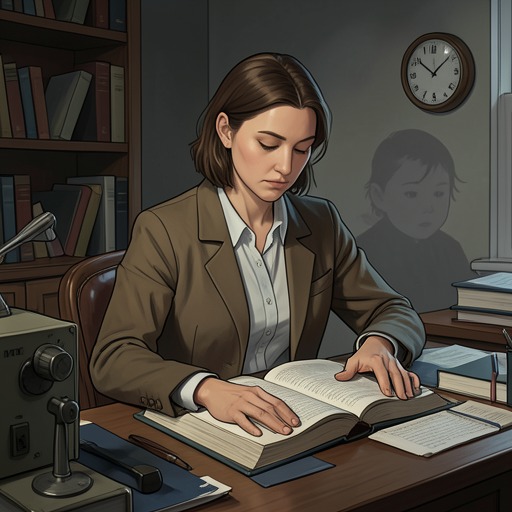
At trial, Alice described the events through the image of a haunting. She said she had feared being alone with the babies because she believed that one day she would be too weak to resist what she called the ghost. At the time, she said, she seemed to be improving: painting helped, and she had begun staying alone with the infants for short periods when they were calm. Then, in her account, darkness fell without warning. She could not remember the details; when the darkness lifted, the babies were wet and cold on the bed. She said she tried to breastfeed both, although she had never done so before, and remembered nothing further until she awoke in hospital.
The Narrator does not accept this account at face value. Alice’s invocation of a nightmare, a ghost, darkness, and amnesia makes The Narrator suspect a confused collection of clichés rather than a detailed, persuasive explanation. That skepticism is important, but it remains the narrator’s judgment, not proof that Alice’s account is false. The trial presents the distance between an accused person’s explanation and the listener’s willingness to believe it as part of the case itself.
A psychiatrist’s evidence was also challenged. The prosecutor established that Alice had no official diagnosis of postpartum psychosis and that the psychiatrist’s view rested on her behavior and on her own account. He agreed that this was the basis for the diagnosis, while maintaining that her reported symptoms matched his recent evaluations. The exchange exposes the evidentiary difficulty at the heart of the trial: the explanation depends partly on interpreting conduct and testimony, yet those are precisely the things under dispute.
The courtroom image and its consequences
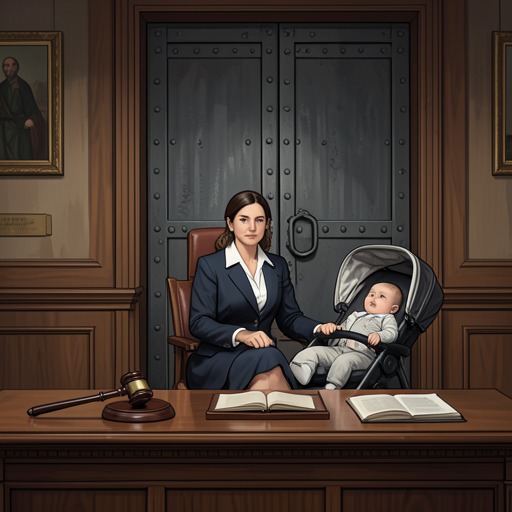
Alice’s appearance in court has been carefully prepared with her lawyer, Carmela Basaguren. She wears a black pencil skirt, a white blouse with a large bow, and no heels; her hair is arranged to avoid making her face seem too harsh. Her hands remain on the table in front of a blank sheet and pen, neither of which she touches. She listens as Carmela whispers to her and keeps her gaze forward. The Narrator, watching from the sixth row, reads the controlled presentation alongside the public suspicion that gathers around a beautiful woman accused of a terrible crime. The image is not neutral: clothing, posture, and composure become part of how the courtroom sees Alice.
When Alice testifies, she speaks Spanish fluently with a marked accent, pausing to find exact words. The Narrator observes that she does not lose her composure before the prosecutor and appears to control her voice with assurance. Her testimony is therefore received not only as an account of events but as a performance whose language, emotional balance, and delivery carry weight. The Narrator’s own response shifts from anxiety and a hope of understanding to doubt, showing how the trial’s competing narratives also reshape the person watching it.
Ritxi’s decision to find Alice a lawyer is another consequential turn. The day after the twins’ cremation, he broke his isolation in La Rioja Alavesa to contact his trusted lawyer and ask for the best criminal defense attorney in the city. Carmela Basaguren accepted the case that day. Her immediate priority was to secure Alice’s release from Prisión de Zaballa; the appeal argued that she was unlikely to reoffend, had ties to the area, and posed no flight risk. The defense also announced that it would seek acquittal on the ground of mental incapacity, invoking Article 20.1 of the Spanish Criminal Code.
The jury’s decision was followed by a court order replacing imprisonment with outpatient psychiatric treatment; Alice was not to be admitted to a psychiatric institution. The decision’s supporters presented outpatient care as workable in light of her economic circumstances and Ritxi’s commitment, while also recognizing weaknesses in the criminal system’s provision for mentally ill offenders. The outcome thus joins Alice’s individual case to a broader debate about criminal responsibility, treatment, and unequal access to support.
Narrative significance
Alice is seen through sharply different frames: a mother at home with two infants, a patient whose hospital speech is confused, a defendant presenting a memory broken by a ghostly blackout, and a poised witness under examination. None of these frames fully resolves the others. The gap in her history, the unexplained change from Jade to Alice, and the contested status of her account keep the narrative from offering a single, complete explanation of who she is or what happened inside her mind.
The Narrator’s prior acquaintance gives the investigation its personal charge, but not the certainty of a solution. Recognizing Alice during childbirth makes memory a bodily and involuntary event; watching her testify later turns recognition into scrutiny. Alice’s case consequently tests both the legal judgment of the court and the narrator’s desire to make a coherent story from incomplete, disputed evidence.